
On this page 8 sections
A name appearing twice in your company’s PSC records is worth checking, especially before you file annual returns. But a duplicate entry or data error is not the same thing as a legal failure to disclose who controls the company. You need to know which one you have before you decide what to do.
The rules behind this are real. Section 119 of CAMA 2020 requires companies to report the people who control them and any changes, and the PSC Regulations 2022 require that information to be accurate and set penalties for specific defaults (CAMA 2020, s.119; PSC Regulations 2022, regs. 5, 11–12).
A real case: how a ₦5,000 filing became ₦19.75 million
A contact at a bank brought a small company’s case to us. Its CAC record showed a PSC change that had been left unfiled for 987 days. When we checked the portal, the bill read ₦19,750,000:
- ₦5,000 to file the notice of change of PSC;
- ₦5,000 for a status report;
- ₦19,740,000 in daily penalties charged to the company, its two directors and its secretary at ₦5,000 each per day, the rate the PSC Regulations 2022 set for small companies (reg. 12(2)(a)).
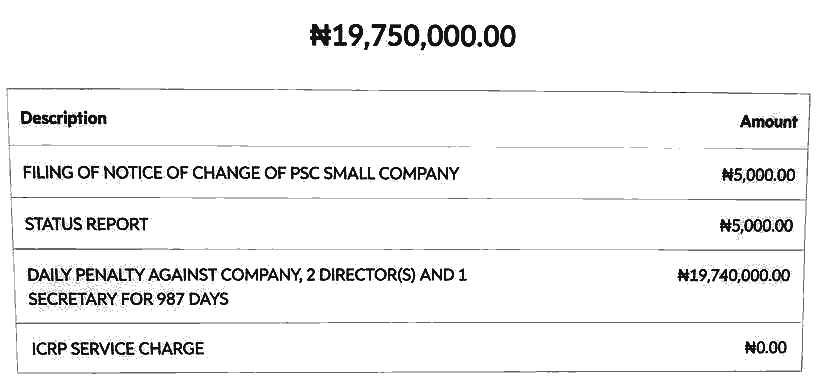
We could review the record but had no access to correct it, so we don’t know how the matter ended, or whether the amount was paid, reduced or challenged. What the portal showed was clear enough: a ₦5,000 filing had turned into a ₦19.75 million assessment.
The arithmetic is simple: ₦5,000 × 4 people (the company, two directors, one secretary) × 987 days = ₦19,740,000. For a private company that isn’t “small”, the same rule charges ₦10,000 a day each; for a public company, ₦25,000. That is why PSC problems should be fixed as soon as you spot them.
What counts as a PSC record problem?
It could be the same person entered twice, a spelling that doesn’t match their ID, a wrong ID number, an outdated shareholding percentage, or a former PSC still shown as active after their control ended. Sometimes two similar-looking entries are actually two different people and not a duplicate at all.
So the first step is to establish the correct ownership and control position, not to delete an entry because it looks similar to another.
Why PSC details matter when filing annual returns
Every annual return must include the company’s PSC information, and CAC will not approve an annual return unless that information is provided (CAMA 2020, s.119(2); PSC Regulations 2022, regs. 3(1) and 12(13)). CAC has also said up-to-date annual returns and PSC information are “mandatory and will be strictly enforced for all processes” (CAC notice), so an unresolved PSC problem can hold up other CAC applications too.
If CAC has queried your application or your records conflict, read the exact query and compare it with your filings and share structure. Some problems need a formal PSC update; others need a data-entry correction or a clarification to CAC.
Five steps to find and fix a PSC discrepancy
1. Collect the current CAC records
Get the company’s latest CAC status report, PSC details, shareholding information and any earlier filing confirmations. Note down exactly which entries you believe are wrong.
2. Identify the actual PSCs
Check who holds at least 5% of the shares or voting rights, who can appoint or remove most of the directors, and who otherwise has significant influence or control. A person can be a PSC without holding 5% of the shares (reg. 14).
3. Work out what changed, and when
Pin down the date of any share transfer, change of control or other reportable event. A new PSC must notify the company in writing within 7 days, and the company has one month from receiving that information to notify CAC (CAMA 2020, s.119(1)–(2)). The longer a change goes unfiled, the longer any daily penalty runs.
4. Choose the right filing or correction route
The regulations provide three forms: CAC-PSC 01 (notification), 02 (change) and 03 (cessation) (reg. 5(1)). A duplicate created by the portal may need investigating rather than another filing for the same person. Confirm the current portal option, and respond to any CAC query, before submitting.
5. Recheck before annual returns
Once CAC processes the correction, check that its record matches the real ownership position. Keep the confirmation receipts. Then file your annual returns; see our CAC annual returns guide.
Does every duplicate mean a penalty?
Not automatically. The penalties in regulation 12 attach to specific failures, such as not reporting PSC information, not identifying the people who control the company, or CAC confirming that the PSC on its record is wrong or that banks or other agencies were given different details (reg. 12(2)–(7)). A typing error spotted and corrected quickly is a different situation from a change of control that was never filed.
What the case above shows is how quickly a genuine default adds up once the daily penalty starts running. If CAC has issued a bill, ask for the breakdown and check which regulation it relies on, which people it charges, and the number of days it counts.
What if CAC shows the company as “inactive”?
A company that defaults on PSC reporting can be shown as “inactive” on the PSC register and CAC’s other portals (reg. 12(1)). Inactive is not the same as struck off. Find out the specific reason recorded against the company before deciding how to fix it.
If your company has already been struck off, see our guide to restoring a struck-off company.
Questions business owners ask
Must I correct PSC information before filing annual returns?
You must make sure the required PSC information is provided, and it must be accurate (regs. 11 and 12(13)). If the record is materially wrong, correct it first.
Will CAC cancel the penalties if I fix the record?
Correcting the record doesn’t by itself entitle you to a waiver. Ask for an itemised statement of the charges and the rule behind each one before you pay or dispute it.
Can Qrafteq help?
Yes. We review the documents you provide, find the mismatch, and advise on the right filing or clarification route. We confirm our professional fee separately from CAC’s charges and any existing penalties.
PSC compliance review
Not sure your PSC record is right?
Send us your company details. We check your CAC record against your share structure, tell you what needs filing or correcting, and confirm our fee in writing before any work starts.
Sources
- PSC Regulations 2022 (CAC)
- CAC notice on annual returns and PSC enforcement
- Companies and Allied Matters Act 2020, s.119 (CAC resources)
- CAC Beneficial Ownership Register
This guide is general information, not legal advice. Check your company’s own CAC record before acting.