

On this page 8 sections
Picture a hypothetical Friday, 4 p.m. A client asks for your CAC status report, your Tax ID and last year’s accounts before releasing a contract. Your certificate is on one phone, the accounts are in an email thread from March, and your last tax payment receipt is a screenshot you cannot find. The client does not wait until Monday.
Fix this with one folder system, one file-naming habit and one calendar of dates. The law sets a firm minimum for tax records: under the Nigeria Tax Administration Act 2025 (section 31), every person in business must keep books or records of account in English, whether or not tax is due, for at least six years after the year of assessment the income relates to.
What the law asks you to keep, and from whom
This guide covers business names and private limited companies. NGOs and trusts have separate rules. The table summarises the enacted provisions of the Act.
| Obligation | Who it applies to | Section |
|---|---|---|
| Keep books of account in English for six years after the relevant year of assessment | Every person in business, including business name owners and companies | 31 |
| File an annual tax return with accounts. A small company may attach an attested statement of accounts instead of audited statements | Every company | 11 |
| File the employee emoluments return by 31 January | Employers | 14 |
| Tell the tax authority about a change of name, address, contact details or 5% shareholders within 30 days | Every taxable person | 9 |
| State your Tax ID on tax documents and on documents issued in respect of a transaction | Every taxable person | 8 |
CAC annual returns are separate from tax returns. Registered companies and business names are both expected to file them, and due dates differ by entity type, so confirm yours on the CAC portal. The definitions of “small company” and “small business” sit in the Nigeria Tax Act, so test your own turnover against them with an accountant. Section 8 says a Tax ID should appear on transaction documents, and how that applies to your ordinary invoices is worth confirming with the Nigeria Revenue Service or your tax adviser.
The five folders
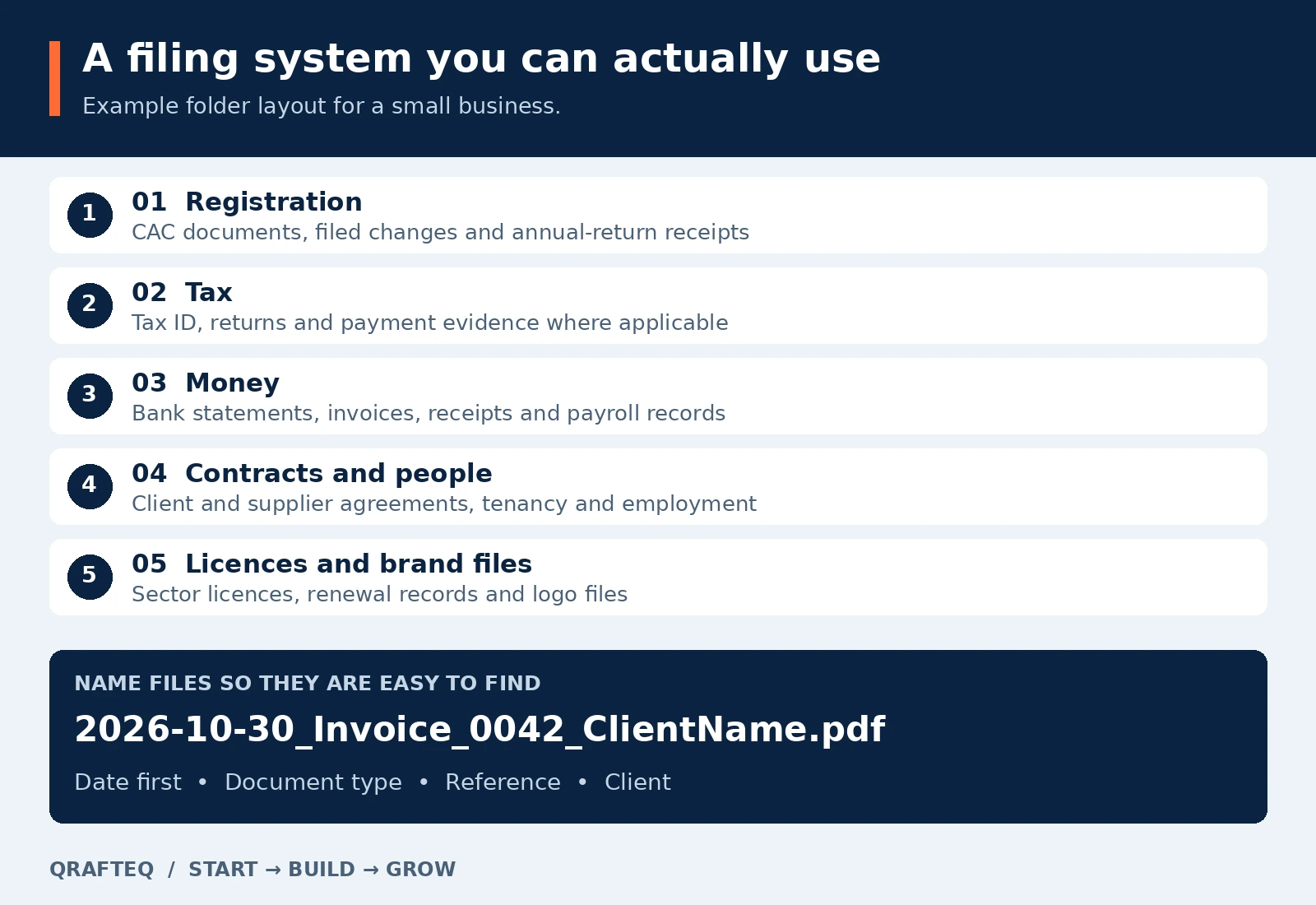
Create these in a cloud drive such as Google Drive, with the same names on your computer.
- Registration. Certificate, certified extract, memorandum and articles (companies), annual returns receipts, a record of every change filed (director, address, PSC), and a recent CAC status report. CAC lists the status report as an instant service, so a fresh copy each year costs you little.
- Tax. Tax ID confirmation, tax returns, payment evidence, and PAYE or VAT records where they apply. Keep any tax clearance certificate you obtain here too.
- Money. Bank statements, invoices you issued, supplier invoices and receipts, and payroll records. Keep the supplier’s invoice, not only your proof of payment.
- Contracts and people. Client contracts, supplier agreements, tenancy papers and employment letters.
- Licences and brand files. Sector licences, domain and hosting renewal records, and logo files. Do not store passwords in the folder. Use a password manager.
A naming habit that saves hours
Name every file with the date first, then what it is, then who it concerns:
2026-10-30_Invoice_0042_ClientName.pdf
Dates at the front sort files in order automatically. Avoid names like “IMG_2291” or “final final 2”. A stranger should be able to find the document without asking you.
A calendar of dates, not a memory
Put every recurring date in one calendar with a reminder two weeks ahead:
- CAC annual returns: confirm your date on the CAC portal.
- Company tax return: not more than six months after the end of your accounting year. A newly incorporated company files within 18 months of incorporation or six months after its first accounting period ends, whichever is earlier (section 11).
- Employee returns: 31 January, if you employ staff.
- VAT returns, if you are VAT-registered: confirm the filing dates with the Nigeria Revenue Service.
- Licence and domain renewals.
Why this matters this year
CAC published a notice on 15 July 2026 of its intention to strike off a further batch of companies, and asked those listed to regularise their records, including outstanding annual returns, within 90 days. A lawyer’s commentary on the notice points out that an intention notice is not the same as an actual strike-off, and that bank statements, invoices, contracts and minutes are the kind of evidence used to show a company was carrying on business. We have not confirmed what happened after the 90 days. Check your own company’s status on the CAC register instead of relying on forwarded lists.
Common mistakes
- Keeping everything on WhatsApp and one phone.
- Mixing personal and business spending in one account, which makes your books impossible to reconstruct.
- Issuing invoices from several templates. Companies must show certain registered details, as our guide to the business letter rules explains.
- Treating e-invoicing as irrelevant. The Nigeria Revenue Service notice we found is addressed to large taxpayers, with a compliance date of 31 July 2026, so it sets no deadline for most small businesses. Watch NRS announcements in case the rollout widens.
- Having nobody else who knows where the folder is.
A one-hour setup
- Create the five folders.
- Download or scan every document you can find and rename it.
- Enter the dates above in your calendar.
- Share the folder with one person you trust.
- Copy the folder to a second location.
If you started with our guide on checking your CAC certificate details, the Registration folder is already done. For the CAC side of the calendar, our guide to CAC annual returns explains the filing.
This is general information, not legal or tax advice. Confirm current requirements with CAC and the Nigeria Revenue Service.
If you want the first-year filings and a proper compliance calendar set up for you, see our compliance support.