

On this page 12 sections
- What kind of logistics business are you building the website for?
- Which pages should a logistics website include?
- Should you display shipping prices?
- What should your quote request form ask?
- Does every logistics website need shipment tracking?
- Should customers pay on the website?
- What makes the website work well on a phone?
- How will customers find the website?
- How much does a logistics website cost in Nigeria?
- Do you need an app as well?
- What should you prepare before speaking to a developer?
- Build the website around the work you want it to do
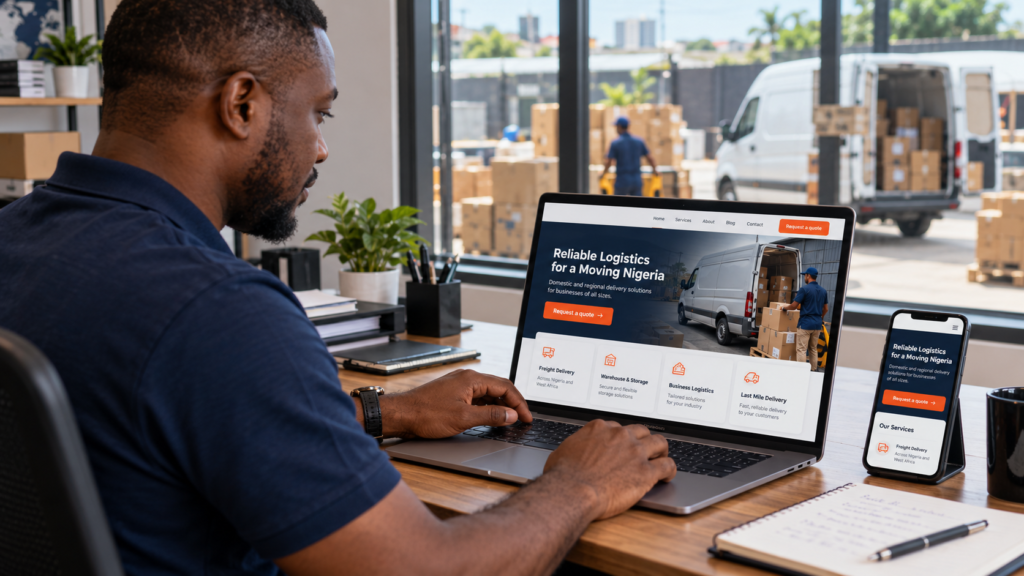
A potential customer gets your company’s name from a referral, and probably searches Google, and opens your website to check whether you handle their shipment.
They want to know where you deliver, what kind of goods you move and how to request a quote. Instead, they find a large photograph of a cargo ship, a promise of “world-class logistics solutions” and a phone number, or/and maybe a WhatsApp button.
The referral has brought them to your door. Your website still has work to do.
Ideally, a logistics website should explain your services and coverage, help customers assess whether you can handle their shipment, and make the next step clear. Depending on how your business operates, that next step could be requesting a freight quote, booking a pickup or checking a shipment’s status, typical of logistics companies, and most other service-focused businesses.
You do not need every feature at launch. But if there is anything you need, it is the right features for the work you do and the customers you serve.
What kind of logistics business are you building the website for?
If you run a dispatch business within Lagos, think about the questions customers ask before handing over a parcel. Can you pick up from their area? Do you deliver to the destination? What will it cost, and when can it arrive? Your website should answer those questions and make it easy to request a pickup.
For interstate deliveries, customers also need to know whether you deliver to their door or expect them to collect from a terminal. Show the routes you cover, the collection points and how to arrange a shipment. Someone sending a parcel from Lagos to Abuja should be able to find the relevant information without calling just to ask whether you serve that route.
A freight forwarder has a different conversation with the customer. Before preparing a quote, you may need to understand the cargo, where it is coming from, where it is going and which part of the movement you are expected to handle. Clear service pages and a form that collects those details will be useful here.
With haulage, the customer may be more concerned about vehicle suitability, load capacity and availability. With warehousing and fulfilment, they will want to understand your location, the goods you can store and how you handle their orders. Give each service enough space to explain what you can actually provide.
You can offer all of these services on one website. Just make it easy for each customer to find their way. A manufacturer looking for haulage should not have to work through parcel-delivery instructions before finding the right contact.
It’s that simple.
Which pages should a logistics website include?
Start with the pages that help customers understand, evaluate and contact your business.
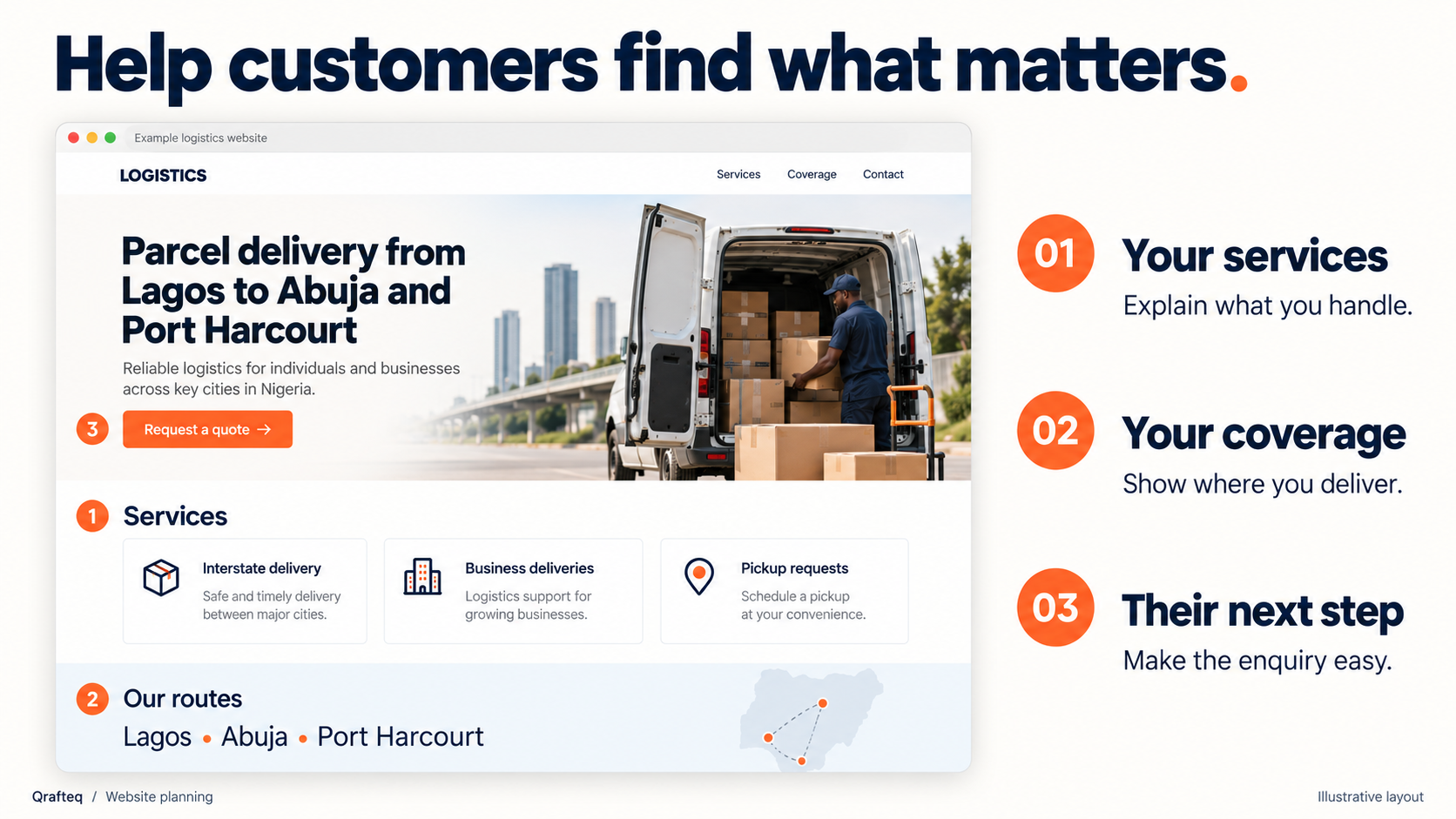
A homepage that explains your business quickly
Your opening message should identify the service and the market you serve.
For example:
“Interstate parcel delivery from Lagos to Abuja and Port Harcourt” tells a visitor more than “Moving possibilities across borders.”
Use wording that reflects your actual coverage. If international shipments are handled through partners, describe that arrangement accurately.
Give the visitor a clear primary action, such as Request a freight quote or Book a pickup. If existing customers frequently visit to track shipments, make tracking easy to find too.
Separate pages for your main services
Air freight, sea freight, customs clearance, haulage and warehousing should not be reduced to five icons with one sentence each.
Each service page should explain:
- What you handle and what you do not.
- The locations or routes you serve.
- What information the customer needs to provide.
- How the process works.
- What affects pricing and timing.
- How to take the next step.
A visitor should leave the page knowing whether the service fits their needs.
Coverage and location information
“Nationwide delivery” needs explanation. Does it mean door-to-door delivery everywhere, selected cities, or collection from partner terminals?
State the practical arrangements. List genuine offices and collection points, explain delivery limitations and distinguish your own facilities from partner locations.
That detail helps customers make a decision and reduces enquiries for services you cannot provide.
An about page with evidence
Give prospective customers something concrete to assess: who runs the business, where you operate and what your team is equipped to handle.
Use real photographs where available. Show relevant credentials accurately and with permission. Describe owned vehicles as owned vehicles, and partner capacity as partner capacity.
A smaller operation presented honestly is more credible than a website that implies infrastructure the company does not have.
A quote or booking page
This page should collect the information your team needs to respond usefully. It should also explain what happens after submission.
If you must review cargo details before accepting a job, call the action Request a quote. A submitted form should not tell someone their shipment is booked when your team has not accepted it.
Should you display shipping prices?
Display prices when you can explain the conditions under which they apply.
A courier with defined delivery zones may be able to publish a rate table. A freight forwarder may need to assess dimensions, cargo type, route and handling requirements before quoting.
Even where a firm price is not possible, explain how pricing works. Customers should understand why you are asking for shipment details.
For example, weight alone may be insufficient. DHL explains that its chargeable weight can depend on the greater of actual and volumetric weight. A quotation tool must follow the pricing rules applicable to your service, rather than applying one formula to every shipment.
If you publish an estimate, identify it as an estimate. State relevant exclusions, any validity period and when the final amount will be confirmed.
A calculator is only useful when its output is dependable enough for the decision the customer is making.
What should your quote request form ask?
Think about what your team usually asks when someone calls for a quote. Where are the goods coming from? Where are they going? What exactly is being moved? Those questions give you a sensible starting point for the form.
Ask for the collection and delivery locations, a description of the goods and the number of packages. Weight and dimensions help your team assess pricing and capacity, but allow customers to leave those details uncertain when they do not know them. Someone sending five cartons for the first time may need you to explain how to measure them.
An “I’m not sure” option keeps that person moving through the enquiry instead of leaving them stuck at a required field.
You will also need their preferred shipping date and the service they are asking about, particularly if you handle freight, clearance and local delivery. Finish with their name and a reliable way to reach them. Keep the first enquiry manageable; your team can request further details once they understand the job.
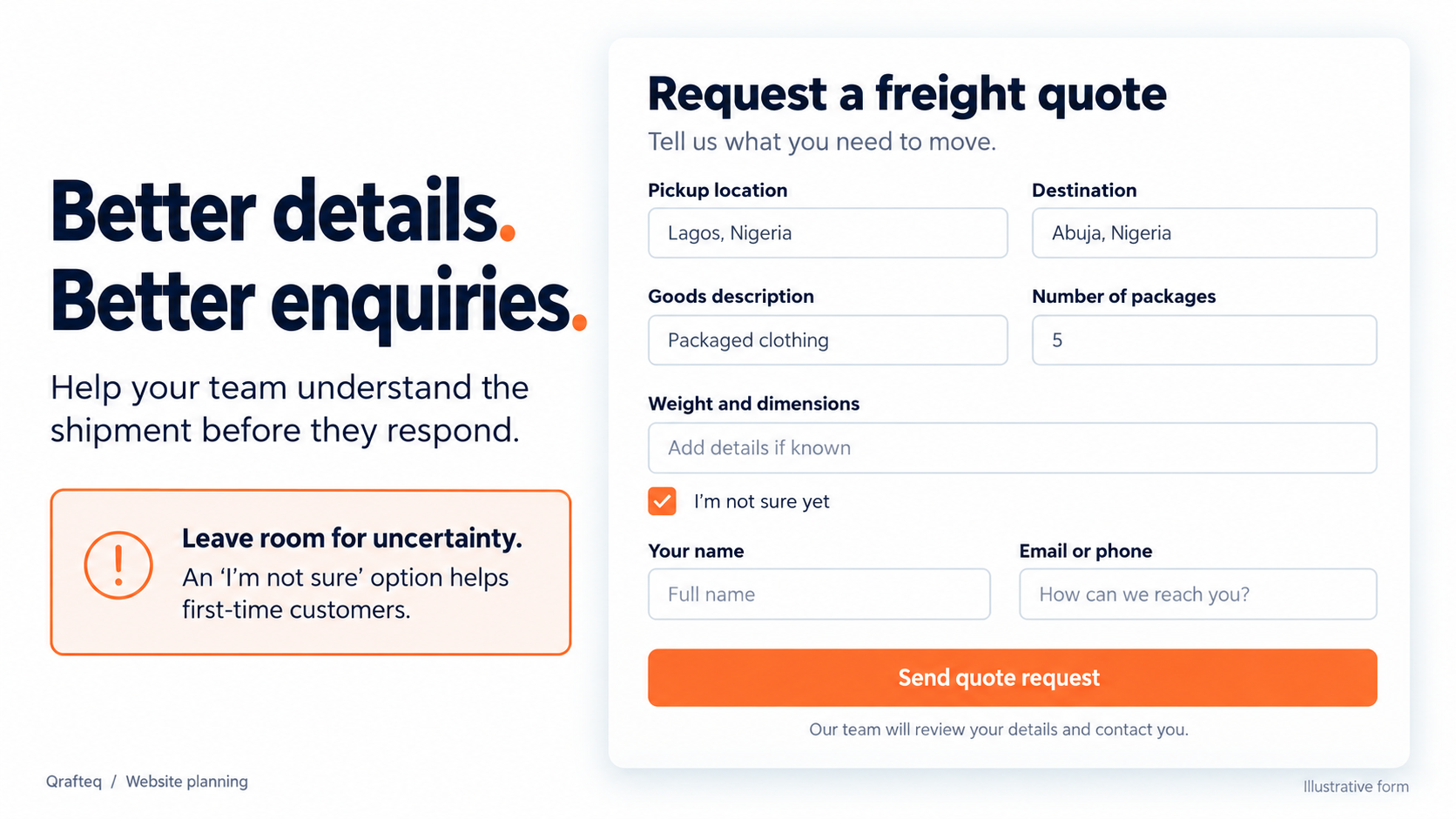
After submission, tell the customer that the enquiry has been received and explain what happens next. On your side, make sure it reaches an inbox or system someone actually checks, with a named person responsible for following up. A well-designed form will not help much if nobody responds.
Where does WhatsApp fit?
WhatsApp can remain part of your sales process. The website should help customers arrive at the conversation with useful context.
A button on your sea-freight page could open a message identifying that service. A quote form could collect shipment details before offering a WhatsApp follow-up.
Customers should not have to repeat everything they have already submitted.
Does every logistics website need shipment tracking?
No. Before adding tracking to your website, ask yourself who will update it. If your team currently checks shipment progress by calling a driver, putting a tracking box on the homepage will not change that. You first need a dependable way to collect the information customers will see.
For a smaller operation, your staff may be able to record updates such as “Collected,” “In transit” and “Delivered.” That can be useful, provided someone is responsible for keeping the records current. Show when the status was last updated and give customers a way to ask for help when an update is unclear.
If you already use shipment software or work with a carrier that provides tracking access, the website may be able to retrieve updates from that system. Your developer will need to check what the provider permits, what access is required and what customers should see when the connection fails or no update is available.
A customer portal becomes worth considering when regular customers need to view several shipments or access related records in one place. The portal still needs a source for its tracking information, whether that comes from your staff or another system. It also needs secure accounts, controls over who can see each record and ongoing support.
Be clear about what you are showing. Staff-entered status updates should not be presented as live GPS tracking, and a map should not suggest a location your system cannot verify. Public tracking results should show delivery progress without exposing customer addresses or sensitive shipment documents.
Should customers pay on the website?
Online payment makes sense when the amount and the service being purchased are clear.
For a fixed-price delivery, payment may form part of the booking process. For a shipment requiring assessment, the better sequence may be enquiry, quotation, acceptance and then payment.
Before adding checkout, decide how your team will:
- Match payments to shipments.
- Confirm successful payment.
- Handle pending or failed transactions.
- Reconcile bank transfers.
- Manage cancellations, refunds and price adjustments.
The payment feature must fit the operational process. Otherwise, you may collect money for a job your team has not yet confirmed it can fulfil.
What makes the website work well on a phone?
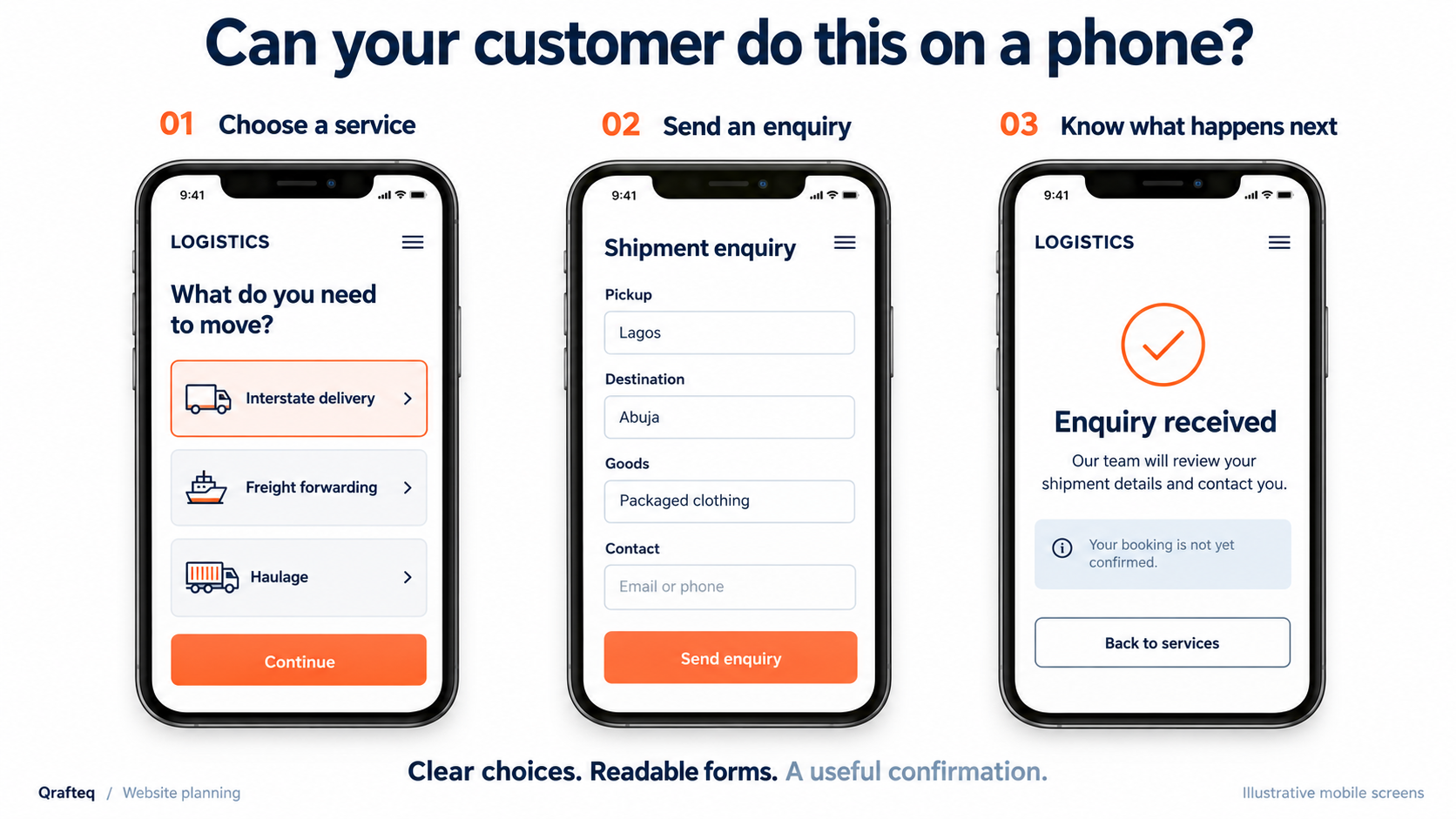
Customers should be able to understand your service and complete an enquiry without struggling with the screen.
Keep forms readable, buttons easy to tap and important information visible without unnecessary animation. Compress photographs and test the pages on an ordinary phone using mobile data.
Check the entire journey. Can someone select a service, complete the form, correct an error and see confirmation?
Also check that floating WhatsApp buttons, cookie notices and promotional bars do not cover form fields or the submit button.
A website can look polished in a desktop presentation and still be frustrating to use.
How will customers find the website?
Build useful pages around the services and locations you genuinely serve.
A detailed page about your air-freight service gives prospective customers more relevant information than a general page that mentions air freight once. Explain the route, process, requirements and limitations in your own words.
Support those service pages with articles answering questions your customers regularly ask. These might cover preparing shipment details, understanding quotations or choosing between available delivery options.
Avoid creating dozens of nearly identical city pages with only the location name changed. Each page should provide information that helps someone make a real decision.
Search visibility takes more than publishing a website. The pages need to be accessible to search engines, useful to customers and maintained as the business changes.
How much does a logistics website cost in Nigeria?
The cost depends on the scope of the website and the systems it must connect to.
A service website with a structured enquiry form is a different project from a platform with automated pricing, customer accounts, shipment tracking and online payments.
Ask for a quotation that separates:
- Website planning, design and development.
- Content preparation and photography.
- Quote, booking or tracking functionality.
- External integrations and subscriptions.
- Hosting, domain renewal and maintenance.
- Training, support and future changes.
Compare proposals against the same requirements. A lower quotation may exclude content, integrations or support included elsewhere.
You should also know which accounts and assets you will control after handover. Ask specifically about the domain, hosting, website administrator access and any third-party subscriptions.
Do you need an app as well?
Start by identifying the task an app would improve.
A business that mainly needs service enquiries may be adequately served by a well-built website. A company with frequent repeat bookings, driver workflows or account-based customer activity may have a stronger reason to investigate an app or portal.
These are different projects. A customer booking app, a driver app and an internal dispatch system should not be treated as one feature called “mobile app.”
Write down who will use it, what they need to do and how often they will use it before commissioning development.
What should you prepare before speaking to a developer?
Bring your service list, coverage information, existing website if any, and examples of the enquiries your team handles.
Also explain where work currently becomes difficult. Perhaps customers repeatedly ask about routes. Perhaps quote requests arrive without dimensions. Perhaps staff spend too much time finding shipment updates.
Those problems provide a more useful starting point than a list of websites whose colours you like.
Agree on the first version, what your team will manage and what can be added later. Before launch, test forms, notifications, tracking and payments where applicable, including what happens when something fails.
Build the website around the work you want it to do
Your first website may need clear service pages, credible project information and a dependable quotation process. A later version may justify tracking integrations or customer accounts.
What matters is whether customers can understand your offer, take the right next step and receive a useful response.
At Qrafteq, we help businesses plan and build websites around those needs. Our portfolio includes logistics and freight-related projects you can review before discussing your own.
See our website projects, then tell us what your logistics business needs. Whether you are starting with a new website or improving an existing one, we can discuss an appropriate scope.