

On this page 10 sections
Imagine a hypothetical Lagos clinic that runs Instagram ads for a month. The ad platform reports 300 link clicks. The website shows some WhatsApp button taps. The front desk remembers “a few” new patients. When the owner asks whether the ads paid for themselves, nobody can answer.
The clicks were real. The missing piece was a way to follow a person from the ad to the outcome.
Before you spend on ads, you should be able to trace one enquiry from its source to its result. If you cannot, you will not know whether the ads worked, even when they did. You do not need an advanced system. You need five links in a chain, and you can test all of them in an afternoon.
The five links
| Link | Question it answers | Simple version |
|---|---|---|
| Source | Where did this person come from? | Campaign tags on ad and social links, read as session source and medium in Google Analytics 4 |
| Landing page | Which page did they arrive on? | The landing page report |
| Action | Did they do something meaningful? | Form submissions and WhatsApp taps recorded as events |
| Enquiry record | Who actually got in touch, and was it a real prospect? | An enquiry log with a source column |
| Outcome | Did it become a sale, and for how much? | The person who closes the sale fills in the result |
Sessions, landing pages and page views are different things
A session is one visit. The landing page is the first page of that visit. A page view counts every page opened. If one visitor reads four pages, that is four page views but one session, so a high page view count can come from a few curious people. When you choose where to send ad traffic, look at landing page sessions and what visitors did next, not page views alone.
Where to use campaign tags, and where not
Campaign tags (UTM parameters) are short labels added to a link, such as ?utm_source=instagram&utm_medium=paid_social&utm_campaign=december-promo. Google explains that they show which campaigns send traffic. Use them on external promotional links only: ads, newsletters, WhatsApp broadcasts and social posts. Never add them to links between pages on your own website, because that can start a new session and overwrite the original source in your reports. Use lower case and the same spelling every time, so one campaign does not appear under three names.
A WhatsApp tap is not a lead
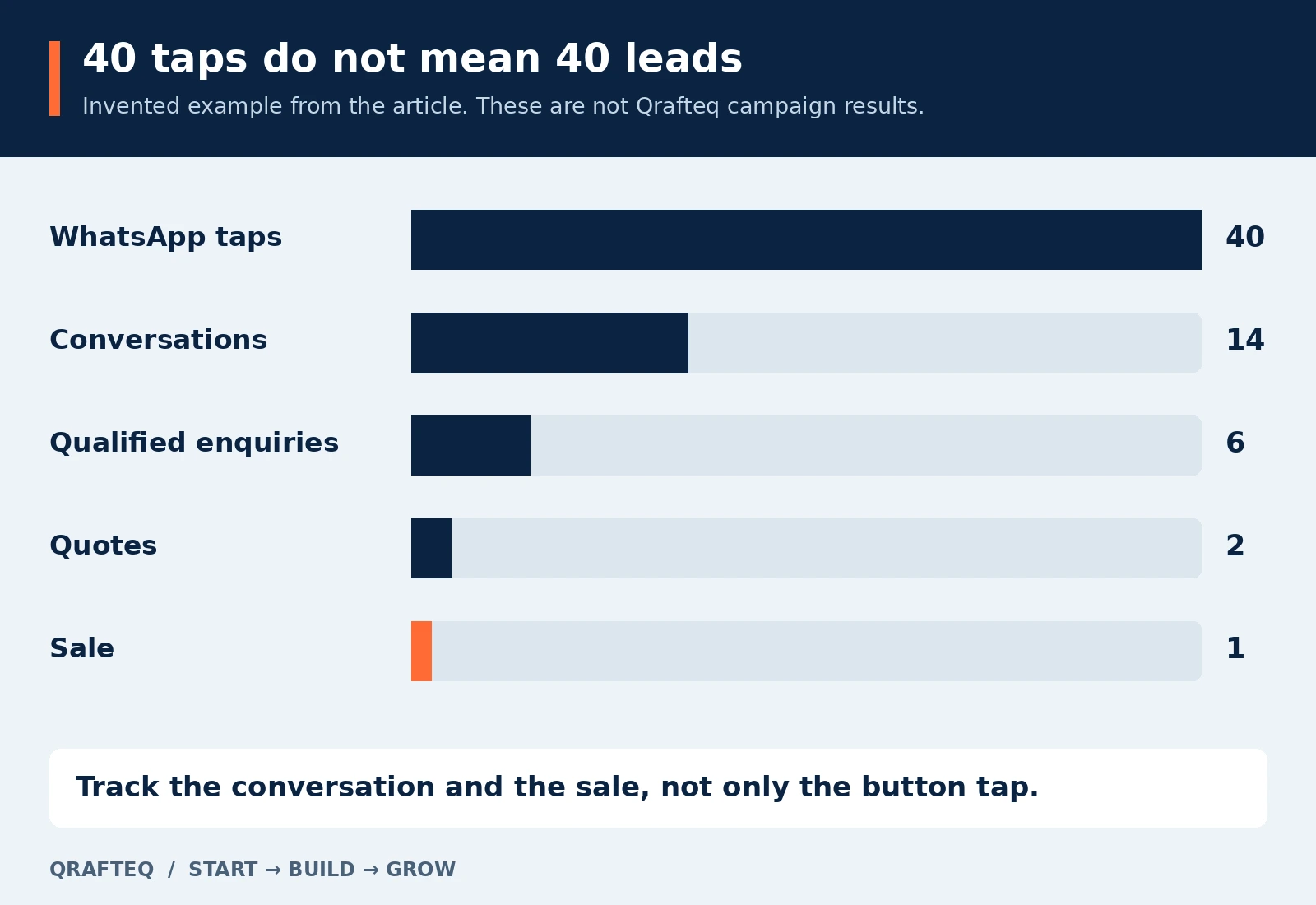
A tap means someone pressed a button. They may not have sent a message. They may have asked something unrelated to buying, or they may be an existing customer. Count in stages:
- Intent signal: the button was tapped.
- Enquiry: a real conversation started.
- Qualified enquiry: you could serve this person and they have a real need.
- Sale: money was received.
Here is an illustration with invented numbers: 40 taps, 14 conversations, 6 qualified enquiries, 2 quotes, 1 sale. Judging the campaign by the 40 taps would hide where you lose people. Judging by the one sale tells you what it cost to win a customer.
Ad platforms also report their own clicks and leads, and those figures will differ from your analytics and from your log. That is normal. Treat your own enquiry log and sales record as the final check.
Test the chain in one afternoon
- Open a tagged link on your phone, as if you were a customer.
- Check that Google Analytics 4 shows the visit with the right source and medium.
- Submit your enquiry form.
- Tap the WhatsApp button.
- Confirm that both actions appear as events.
- Add the test to your enquiry log and close it with a pretend sale.
Whatever breaks is what you fix first. The log from our article on what happens after someone enquires on your website works well as the enquiry record here.
Write down a baseline first
Before the ads start, record the last 30 complete days: sessions to the page you will advertise, enquiries per week, and the share of enquiries that became sales. Without a baseline, any movement looks like success. Do not judge the ads after a few days either. Give each campaign the same length of time before you compare.
What to review after the first campaign
When the campaign period ends, go through the same questions each time:
- How many sessions reached the landing page, and from which source and medium?
- How many of those sessions recorded a form submission or a WhatsApp tap?
- How many taps and forms became real conversations in your log?
- How many conversations were qualified, and how many ended in a sale?
- What did the campaign cost, and what was the revenue from the sales you can trace to it?
Divide the amount spent by the number of sales you can trace, and you have a first rough cost of winning a customer. Treat it as a rough figure while the numbers are small. Our customer acquisition cost calculator on the business tools page can help you work it out from your own figures.
If the chain is not ready
You can wait, or you can run a small test with money you can afford to lose while you fix tracking. Be honest that a test with weak tracking teaches you little. Our guide on when to start running ads covers the readiness side of the decision, and the free business tools include calculators that help you check results against your own figures.
Common mistakes
- Judging results by the ad dashboard alone.
- Tagging internal links.
- Counting taps as leads.
- Never asking the sales person to report outcomes.
- Changing the offer, the audience and the landing page at the same time, so nothing can be learned.
If you want help with measurement and conversion setup before you spend on ads, see our Grow service.