

On this page 7 sections
Imagine a founder in Lagos who collects her CAC certificate on a Friday. By Monday she has ordered branded invoice books, a signboard and a rubber stamp. On Tuesday her accountant notices that one director’s surname is spelt differently from the one on her passport. Everything she has printed now carries the wrong details. This is a hypothetical example, but the pattern is common: the certificate arrives, the excitement takes over, and nobody reads the details line by line.
Before you print, pay or sign anything in your new business name, check seven details on the documents CAC issued to you. Then confirm your Tax ID and start one folder for your records. It takes about an hour, and it costs far less to correct a mistake before your name, number and address appear on invoices, contracts and bank forms.
What you should be holding
This guide covers registered business names and private limited companies. Incorporated trustees (NGOs) have different documents and are not covered here.
CAC says registration on its portal ends with an electronic certificate of registration and a certified extract of the registration information. A limited company also has its memorandum and articles of association. Download all of them, save them in two places, and read them before you do anything else.
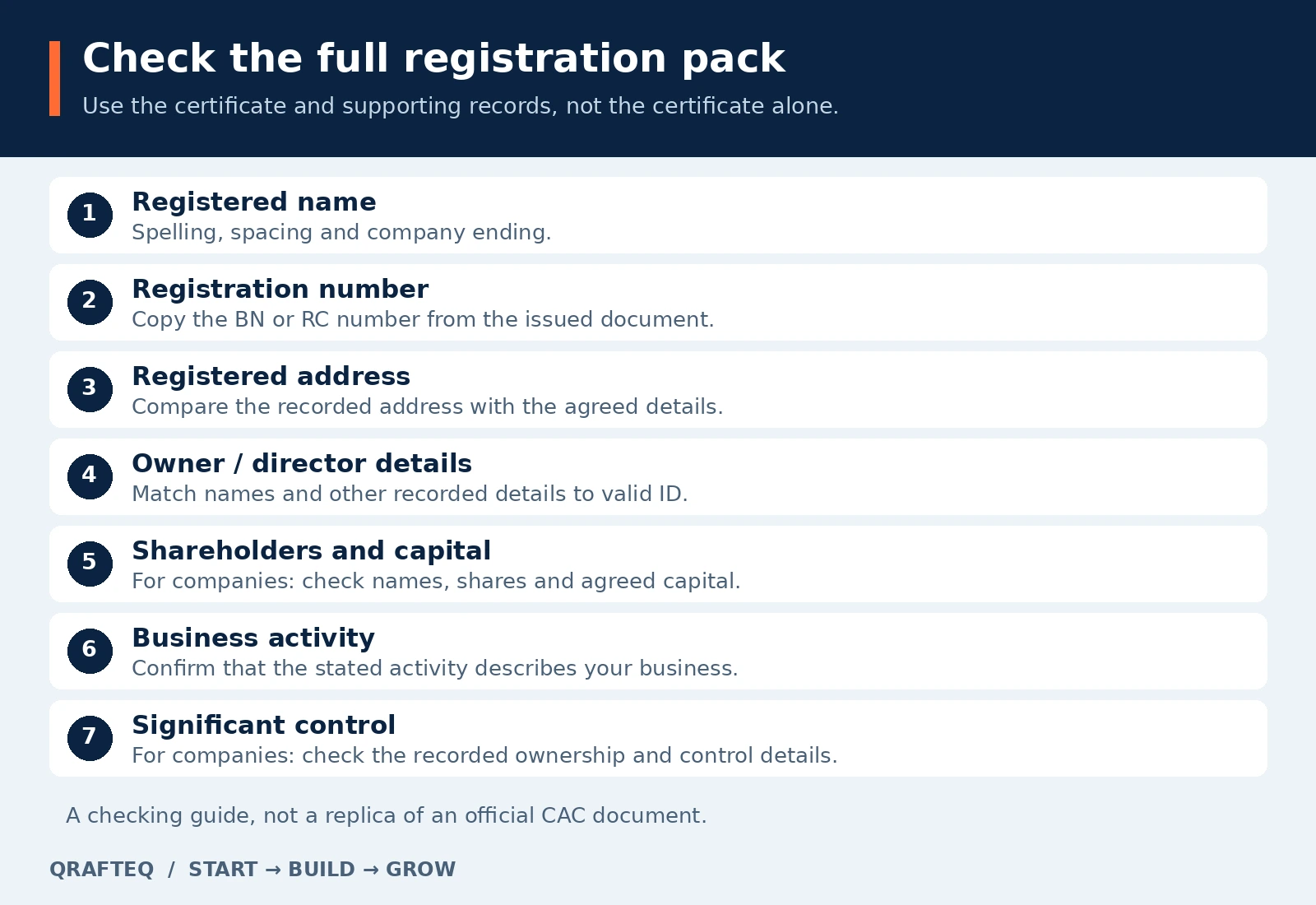
Seven details to check
- Name. Check the spelling, spacing and ending, such as “Ltd” or “Limited” for a company. This is the name your contracts, invoices and bank account will carry, so it must match exactly.
- Registration number. A business name has a BN number and a company has an RC number. Copy it from the certificate, never from memory. Companies must show certain registered details on business letters and invoices, and our guide to CAC’s business letter rules lists them.
- Registered address. Use an address where you can actually receive letters. If you are a diaspora founder, confirm that someone reliable can collect post there. Changing the address later is a filing with CAC. CAC lists a change of registered address among its post-registration services for companies.
- Owner and director details. Names, dates of birth and addresses should match your government ID. A one-letter difference can delay a bank account or a later filing.
- Shareholders and share capital (companies). Confirm each shareholder’s name and number of shares, and check the share capital figure against what you agreed.
- Nature of business. The business activity or objects on your documents should describe what you really sell. CAC’s own FAQ explains that it can ask a company to raise its issued share capital when the capital is below the minimum prescribed for the objects chosen. Objects and capital are linked, so changing one later may mean a filing.
- Persons with significant control (companies). Check that the people who ultimately own or control the company are recorded. CAC lists a change of PSC as a post-registration service, and our PSC guide explains the requirement.
If something is wrong
Do not start printing, and do not ask the bank to proceed. Write down the error, gather the document that proves the correct detail (a valid ID or proof of address), and raise it through the CAC portal or the agent who registered the business for you.
Corrections that touch a name, director, shareholder or address are filings with CAC, so confirm the fee before you commit. CAC’s published service timelines list 12 working hours for many company changes, including a change of registered address, and 48 working hours for business name applications, counted from a complete application. Treat those as CAC’s targets rather than promises, because a query can add time.
Three things to do in the same week
1. Confirm your Tax ID. For businesses, the Nigeria Revenue Service says your Tax ID is derived from your CAC registration. You can retrieve and check it on the official Tax ID portal. The portal describes retrieval as a confirmation step, not a new registration, and it will flag inconsistent records so you can fix them early. If you want to understand the older JTB certificate language you may still hear from banks, our guide on how to verify your Tax ID covers it.
2. Open the business account with matching documents. The Nigeria Tax Administration Act 2025 (section 8) says banks and similar institutions must treat a Tax ID as a precondition for opening or operating an account. Banks set their own document lists, so ask each one what it wants. The details above are what they will compare.
3. Start the records folder. Create a folder called Registration. Put every CAC document in it with the date you received it, and add a note of your registered address, directors and the date of each change. You will need to find these papers quickly sooner than you expect.
Common mistakes
- Assuming everything is correct because the certificate arrived.
- Using a personal address or phone number that will change within the year. The tax law also expects you to tell the tax authority about a change of address or contact details within 30 days (Nigeria Tax Administration Act 2025, section 9).
- Giving the bank details that differ from the CAC record.
- Keeping the only copy of the certificate on one phone.
What this guide does not cover
This is general information, not legal or tax advice. Fees, portals and procedures change, so confirm current details with CAC and the Nigeria Revenue Service. For the wider list of systems a new company should put in place, see our checklist of what to do after registering your company.
If you would rather have someone check the documents and sort out the Tax ID and bank account with you, see our post-incorporation support.