
On this page 11 sections
- What does a hotel booking engine do?
- What does a PMS do for the hotel?
- When does a channel manager become useful?
- Follow one booking before choosing the software
- Do you need all three systems immediately?
- Will a channel manager stop every double booking?
- How should payment work for a Nigerian hotel?
- Can you keep the hotel’s existing website?
- What should you ask the developer and software supplier?
- What should you test before going live?
- Build around the way your hotel accepts a guest
Someone offers to build your hotel website and says it will come with a booking system. That sounds fine. Guests choose a room, make a reservation and your team receives it.
Then another provider asks whether you have a PMS. Someone else mentions a channel manager. Before long, you are discussing three different products when all you wanted was a website that helps people book.
The names can make this more confusing than it needs to be. Start with the work each system is supposed to do.
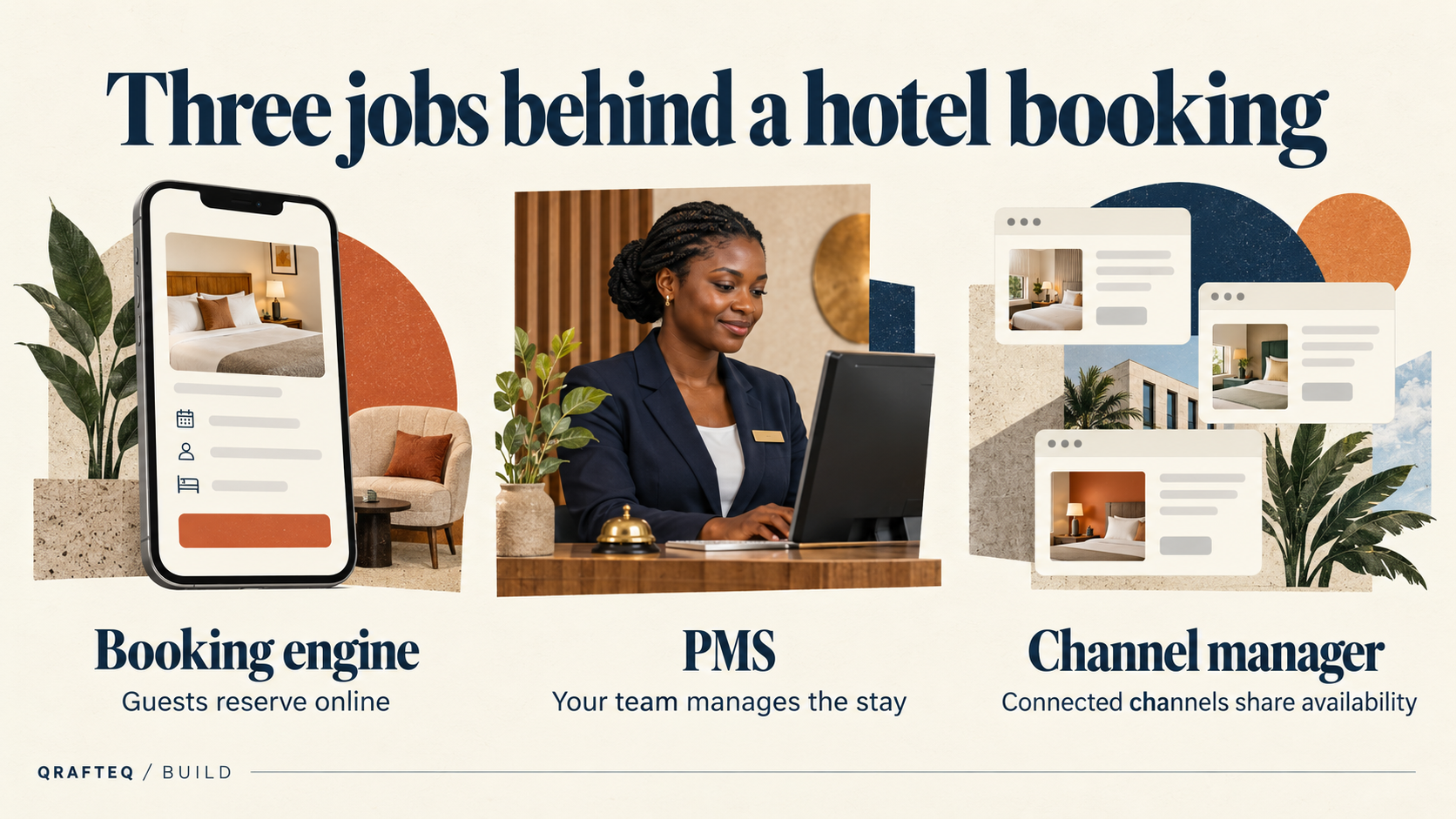
A booking engine lets guests reserve through your website. A property management system, or PMS, supports the hotel’s internal operations. A channel manager shares rates and availability with connected booking platforms and brings reservations back. Some providers combine these functions. Others sell them separately.
What matters is how a booking moves from the guest’s phone to the person preparing the room.
What does a hotel booking engine do?
A booking engine is the part your guest uses to select dates, see available room options and submit a reservation. Depending on the setup, it can also collect a deposit or full payment, apply booking conditions and issue confirmation.
Your website might open it on a separate booking page or display it within the site. Either arrangement can work. The guest should understand that they are still booking with your hotel, and the process should be usable on a phone.
But a form asking for a name, phone number and preferred dates is not necessarily a booking engine. It may simply send an availability request to reception.
That is a valid starting point if your team must check before accepting a stay. Label the action “Request availability” and explain when the guest should expect a reply. Reserve “Booking confirmed” for a reservation your process has actually accepted.
What does a PMS do for the hotel?
The PMS is mainly for your team. It can hold reservation records, room assignments and guest details, with functions for arrivals, departures, housekeeping and billing depending on the product.
Think about what reception needs to know at the start of a shift. Who is arriving? Which guests are staying another night? Which rooms need cleaning? Which reservation has an outstanding balance?
Those are operational questions. A polished booking page does not answer them by itself.
Cloudbeds’ explanation of these system roles describes how a connected PMS receives reservations and exchanges availability with a channel manager. The exact functions still need checking against the product and plan you are considering.
When does a channel manager become useful?
A channel manager becomes useful when you sell rooms through several connected platforms and need those platforms to work from coordinated rates and availability.
For example, you may take direct reservations on your website while also listing rooms on Booking.com or another online travel agency. A reservation through one route needs to affect what remains available through the others.
Without a suitable connection, someone may have to update each platform manually. The difficulty is keeping those updates consistent, particularly when reception is busy or reservations arrive close together.
Ask which channels are supported and what information moves between them. A provider saying “we integrate with booking platforms” is not enough to establish that your particular accounts, room types and booking rules will work.
Follow one booking before choosing the software
Imagine a small hotel in Abuja with one Executive room left for Friday night. This is an illustrative example.
A guest books that room through the hotel’s website. Reception needs the reservation, the agreed rate, the guest’s details and the payment status. The remaining availability for that room type should also change wherever the hotel sells the same inventory.
Now add a walk-in guest. If reception accepts that person but does not record the reservation in the system that controls availability, the website may still offer a room that is no longer available.
That is why the staff process belongs in the website discussion. Decide where every accepted reservation is entered, including those received by phone or WhatsApp, and who makes that entry.
Ask the supplier to demonstrate this exact situation. A tour of the dashboard is useful, but watching the last available room move through the booking process tells you much more.
Do you need all three systems immediately?
You do not have to buy three separate products. First establish what you already use and what is missing.
If you run a guesthouse with a manageable number of enquiries and confirm stays manually, a clear website with an availability-request process may be a reasonable first version. You still need an accurate reservation record and someone responsible for updating it.
If you want guests to make confirmed reservations without waiting for a reply, you need a dependable way to show availability and apply your booking conditions. That is where a booking engine becomes relevant.
If you are also selling across several external platforms, investigate a channel manager and its connection to your reservation system. A PMS may already include a booking engine and channel manager, or offer them as additional modules.
Room count alone should not decide this. Look at how reservations arrive, how often staff repeat the same entries and where errors currently happen.
Planning this for your hotel? Qrafteq can help you define the website journey, identify what needs to connect and establish what must be confirmed with your software provider before development. Explore our website development service or tell us how your hotel currently receives bookings.
Will a channel manager stop every double booking?
Do not treat it as a guarantee. Connected systems can reduce the manual work involved, but you still need correct setup, accurate records and a process for dealing with failed updates.
One detail worth checking is room mapping. The Executive room listed on a booking platform must be connected to the correct room type in your system. Cloudbeds’ channel setup guidance, for example, requires OTA rooms to be mapped to the corresponding room types or disabled on that channel.
Also ask what “sync” means. A calendar connection is not necessarily equivalent to a full integration. Cloudbeds distinguishes calendar-based connections from API connections: calendar connections exchange availability, with more limited information than a supported API connection.
Get a clear answer about failed updates. Who sees the alert? Who investigates? Can your team temporarily stop selling affected rooms while the issue is resolved? These are useful questions to ask before launch.
How should payment work for a Nigerian hotel?
Explain your payment arrangements before anyone configures checkout. Do you require a deposit? Do you accept payment on arrival? What happens when someone pays by bank transfer?
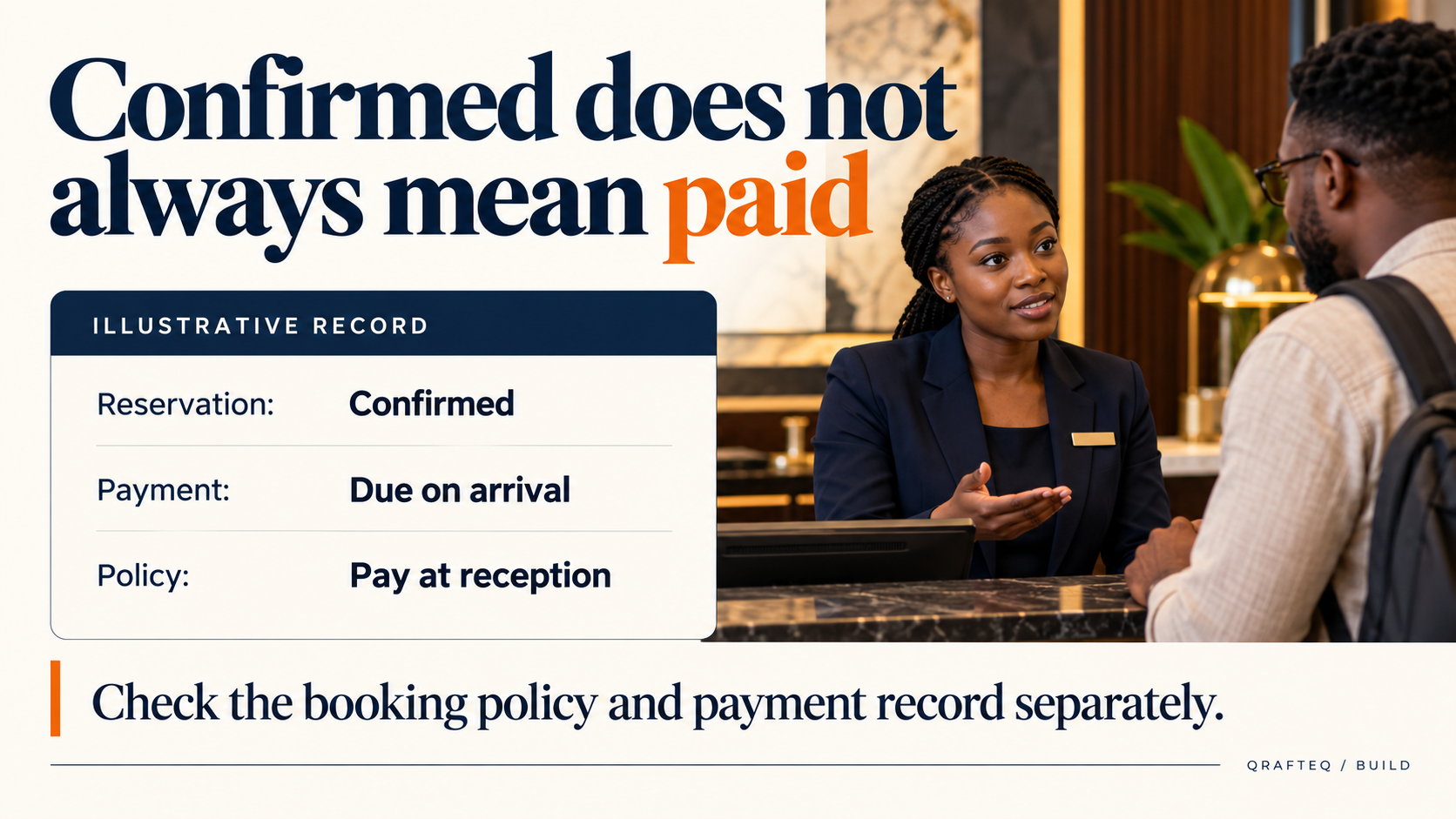
The booking status and payment status should be understandable separately. A reservation might be accepted under a pay-on-arrival policy without being paid. Another might remain pending until a required deposit is verified.
If you accept transfers, agree who verifies receipt and records it against the reservation. A guest uploading a transfer screenshot should not automatically make the record “Paid”.
For online payments, ask the provider to confirm support for your Nigerian business, settlement arrangements, accepted currencies and the specific booking integration. Do not assume that a payment option advertised on a software website is available for every country or account.
Then test the awkward cases. Payment succeeds but the confirmation page does not load. The guest taps twice. A payment remains pending. Reception changes the stay after a deposit has been received. Your team should know how to resolve each situation without creating duplicate reservations or asking the guest to pay again unnecessarily.
Can you keep the hotel’s existing website?
Possibly. An existing website may be able to link to a supported booking engine or accommodate an approved integration. You need to check the website platform, the booking provider’s options and the work required.
Do the same check if your hotel already uses a PMS. Give the developer its exact name and plan, then ask the provider which booking engines and channel managers it supports.
The existence of an API does not mean any developer can connect immediately. Access, compatibility and provider requirements still matter. SiteMinder’s developer guide, for example, describes distinct integration routes for PMS providers and booking channels.
If the connection has not been confirmed, keep it as a requirement to investigate. It should not quietly become a promised feature in your website proposal.
What should you ask the developer and software supplier?
Bring both parties into the same discussion where possible. Otherwise, you can end up with a website developer waiting for the software supplier while the supplier says the website is outside its support.
Ask who handles the connection, who sets up room types and rate plans, and who tests the complete booking journey. Find out whether reception will receive training and who responds when reservations stop coming through.
You should also know which accounts belong to the hotel, which subscriptions must stay active and how to export your reservation records if you change providers. Ask about recurring charges and integration requirements before committing.
A useful written scope describes the actual behaviour. “Guests can select available dates, pay the required deposit and receive confirmation, with the reservation visible to reception” is much clearer than “advanced hotel booking functionality”.
What should you test before going live?
Start on a phone and complete a test reservation using an agreed test method. Check the dates, number of guests, room type, rate conditions and confirmation. Then check the same record at reception.
Test the last available room across connected channels, a cancellation, a date change and a room taken out of service. Confirm what happens to availability after each action. Include a phone reservation entered by your staff, because that is part of the same inventory.
Check payment failures and pending payments where applicable. Make sure the guest receives accurate wording and that reception can tell what happened.
Finally, agree what staff should do when a connection or internet access fails. They need a workable way to record enquiries, avoid unsupported promises and reconcile records when service returns.
Build around the way your hotel accepts a guest
Before choosing software, write down what happens from the moment someone selects dates to the moment reception prepares for their arrival. Include payment, confirmation, cancellations and reservations taken outside the website.
That gives you a useful basis for deciding what the website needs and what your hotel systems must handle.
Qrafteq can help you plan and build the website around that process, with integrations assessed against the systems you use. Tell us about your hotel, your current website and how you manage reservations. We can work through the requirements before recommending the scope.